Shop our best deals online.
Shop Now
How to Put a Wood Floor in a Bedroom Without the Noise
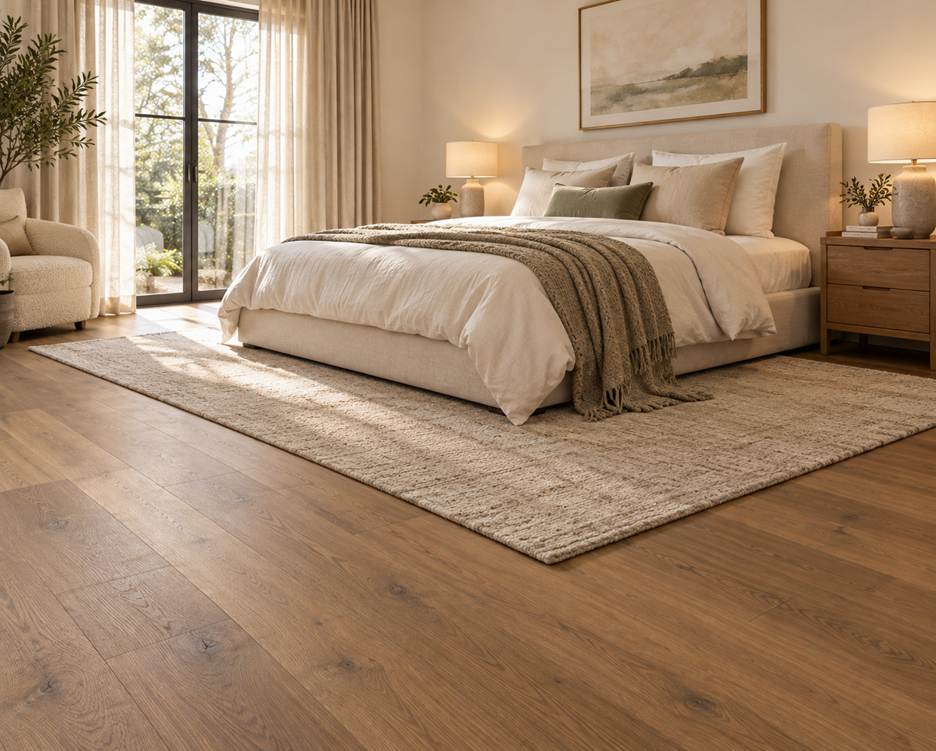
Table of Contents
- 1 What a Bedroom Floor Has to Do
- 2 Is a Wood Floor in Bedroom Spaces Too Noisy for Sleeping?
- 3 Will It Feel Cold Underfoot?
- 4 How Wood Compares With Carpet and Laminate
- 5 What the Impact Numbers Mean
- 6 Rugs and Furniture Placement
- 7 Humidity in a Closed Bedroom
- 8 Questions to Ask About Underlayment
- 9 Doorways and Closets
- 10 Where Wood Is Not the Best Bedroom Choice
- 11 Setting Up a Wood Bedroom Floor for Quiet and Warmth
- 12 Choosing Engineered, White Oak, or Laminate
- 13 Planning a Bedroom Floor With Flooring Outlet & More
- 14 Sources
- 15 Frequently Asked Questions
- 15.1 Q: Is a wood floor in bedroom spaces too noisy for sleeping?
- 15.2 Q: How do I keep a wood floor from feeling cold?
- 15.3 Q: Is engineered hardwood flooring good for bedrooms?
- 15.4 Q: Does a humidifier in the bedroom harm a wood floor?
- 15.5 Q: Is laminate flooring in a bedroom a good alternative to wood?
If you are planning a wood floor in bedroom spaces, you are probably asking two fair questions: will it be noisy, and will it feel cold? Wood brings warmth and a clean, low dust surface, but it has no cushion, it reflects sound, and it feels different under bare feet than carpet does. Both issues have clear causes and practical fixes such as acoustic underlayment, rugs, and careful subfloor preparation.
This guide covers where bedroom noise and cold come from, how wood compares with carpet and laminate, how rugs, underlayment, and humidity control help, where wood is not the best choice, and how to set up the floor so the room stays quiet and comfortable. In a condo or apartment, the building may also set its own sound rating rules for the floor and ceiling assembly.
What a Bedroom Floor Has to Do
A bedroom floor is judged by different standards than a kitchen. It should stay quiet at night. It should feel good when you step out of bed. It should be easy to keep clean. Solid and engineered wood can meet all three when the install suits a bedroom. Our solid hardwood range and our engineered boards both fit. The tradeoffs come down to sound and warmth and humidity.
Is a Wood Floor in Bedroom Spaces Too Noisy for Sleeping?
Bedroom sound comes from three sources. The first is impact noise. That is the thump of footsteps traveling through the floor into the room below. The ICC acoustics guide explains that the impact insulation class rates a floor and ceiling together. The code asks for IIC 50 between dwellings. The lab test is ASTM E492. The rating belongs to the whole assembly. Ask for the tested rating of floor and underlayment and ceiling as a set.
A Simple Walk Test
A simple walk test shows how loud your floor is. Have someone walk across the room in socks. Stand in the room below. Listen for the thump. Listening to footsteps from the room below can help identify noticeable sound transmission, but it cannot establish a building’s acoustic rating. For apartments or condominiums, confirm the required performance and compatible flooring assembly before choosing underlayment.
Echo and Squeaking
The second source is echo. Hard surfaces reflect sound. A bare floor can make a room sound brighter. CRI describes area rugs as a way to soften hard surfaces and cut noise. The third source is squeaking. That is a board moving against a fastener or a neighbor. Our guide on what causes engineered hardwood squeaking shows how to trace it.
Will It Feel Cold Underfoot?
Why Wood Feels Cold
Cold feet on wood have a measurable cause. The Wood Handbook lists structural softwood at 0.10 to 0.14 watts per meter kelvin for heat flow. White oak is 0.19 at 12 percent moisture. Concrete is 0.9 and aluminum is 216. The Handbook says wood does not feel extremely hot or cold to the touch. So wood feels warmer than concrete or stone.
Carpet and Subfloor Conditions
Carpet insulates better. CRI says carpet surfaces are usually warmer than cold hard floors. It reports R-values from 0.5 to 4.0 for carpet and cushion tests. A bedroom over a crawl space or garage can still have a cold subfloor. Insulation under the floor helps. Some engineered boards are rated for radiant heat. Our radiant heat flooring compatibility guide explains what to check. A rug beside the bed and another at the closet cover the spots where bare feet land.
How Wood Compares With Carpet and Laminate
| Feature | Wood, Solid or Engineered | Carpet | Laminate or Vinyl Plank |
| Warmth underfoot | Moderate; improves with rugs | Highest | Moderate; similar to wood |
| Footstep noise to the room below | Higher without underlayment | Lowest | Higher without underlayment |
| Echo inside the room | Higher; softened by rugs | Lowest | Higher; softened by rugs |
| Dust and allergen control | Easy to clean | Holds dust until vacuumed | Easy to clean |
| Look over time | Can be refinished a limited number of times | Wears and mats | Cannot be refinished |
If sleep comfort is the only goal then carpet is quietest and warmest. A laminate flooring bedroom behaves much like wood. It is also a hard floor. The same underlayment and rug advice applies. Our guide to the best bedroom flooring covers the full range.
What the Impact Numbers Mean
The ICC guide uses two ratings. The sound transmission class rates airborne sound such as voices. The impact insulation class rates footsteps and dropped objects. For floors that separate dwellings the code asks for 50 on each. A field test can use 45. The guide defines the apparent impact insulation class as a measure of the whole floor and ceiling system. That includes sound that leaks around the edges. This is why a thick underlayment alone does not guarantee a result. The ceiling below and the way the floor meets the walls both count.
Rugs and Furniture Placement
A rug is the quickest fix. Put one beside the bed. Add one where you step out of the bedroom door. CRI describes area rugs as a way to add comfort and cut noise. Choose a rug pad labeled safe for wood finishes. Some rubber backed pads can mark a finish over time.
Felt pads under the bed frame stop the scrape of legs. These small steps help a wood floor in bedroom spaces feel quieter and softer.
Humidity in a Closed Bedroom
People sleep with the door shut. A humidifier or a dehumidifier may run all night. That can push humidity outside the range your floor likes. The Wood Handbook gives wood moisture at 70 degrees. It is about 6.2 percent at 30 percent humidity and 9.2 percent at 50 percent. A larger swing means a larger change in board width. Check the room with a small hygrometer. Hold the level steady and the floor stays tight.
Questions to Ask About Underlayment
Not every underlayment performs the same. Ask which rating the maker reports. Ask whether that rating comes from a lab test or a field test. Ask which floor and ceiling it was tested with. Ask whether the product suits your install method. A floating floor and a glued floor use different products. Match the underlayment to the floor the maker specifies. Ask whether the underlayment affects the radiant heat rating. If you rent or own a condo then ask the building for its written rule first. That rule decides which products you may use in a wood floor in bedroom spaces.
Doorways and Closets
Edges decide how quiet a floor stays. A board pinned too tight against a wall or door frame can creak. Leave the gap the maker specifies. Use transition strips that let the floor move at the closet and the bedroom door. Cover the gap with baseboard. Check the strips each season. A laminate flooring bedroom needs the same edge care as wood. Both are often installed as floating floors.
Where Wood Is Not the Best Bedroom Choice
Noise and Condo Rules
A bedroom over a living area where people stay up late is the hardest case. A condo may also require a tested impact rating. A nursery or child’s room that sees crawling and falls may suit carpet or a softer floor.
Humidity Limits
Humidity is the other limit. NWFA gives 30 to 50 percent as the general rule for solid wood. It says to follow the maker’s range for engineered floors. A humidifier running all night in a closed room can push humidity outside that range. A small hygrometer shows where the room sits. Our guide to the ideal humidity for hardwood floors explains seasonal swings.
Setting Up a Wood Bedroom Floor for Quiet and Warmth
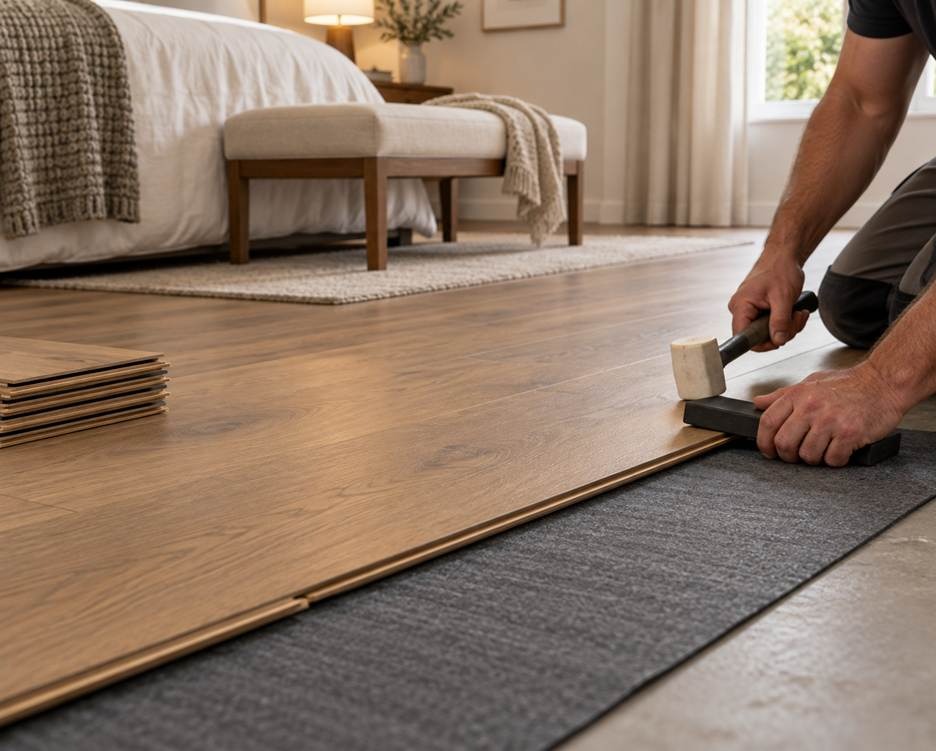
The install largely decides the comfort. Focus on these steps:
● Subfloor: start with a flat and dry and firmly fastened base.
● Acclimation: Follow the flooring manufacturer’s requirements for storage, moisture testing, and acclimation before installation.
● Underlayment: where appropriate, use an acoustic underlayment approved for the flooring product and installation method. In multifamily buildings, confirm the required sound rating for the complete floor and ceiling assembly.
● Expansion gap: leave the gap the maker specifies. Hide it under the baseboards.
● Felt pads: fit pads under the bed frame and nightstands.
Choosing Engineered, White Oak, or Laminate
Engineered Hardwood
Engineered hardwood flooring suits a typical bedroom. Its layered build limits movement. Flooring Outlet & More carries engineered hardwood in a range of species and widths and finishes. The product pages list plank width and thickness and the install methods each line allows. Check the rated method and the radiant heat rating. Our guide on how to select engineered hardwood flooring helps narrow the choice.
White Oak
White oak flooring is a steady choice. Its look suits a calm bedroom. A matte finish hides dust and small scratches better than a glossy one. Plan the same underlayment for white oak flooring as for any other species. Use transition strips at the closet and bedroom door. They let the floor move. When choosing underlayment for a bedroom, compare sound insulation ratings and confirm compatibility with your flooring and installation method.
Planning a Bedroom Floor With Flooring Outlet & More
Flooring Outlet & More is a San Jose flooring store at 1757 Junction Ave., Suite A. Contact us today to talk through underlayment and flooring options for your bedroom.
Sources
USDA Forest Products Laboratory, Wood Handbook, Chapter 4: Moisture Relations and Physical Properties of Wood (2021). US government research. Supports the heat flow figures and how wood feels.
The Carpet and Rug Institute, The Carpet Primer (2017). Industry trade group. Supports the carpet insulation and area rug and dust statements.
National Wood Flooring Association, Wood Flooring Installation Guidelines (2025). Industry standard-setting body. Supports the humidity range and the follow-the-maker rule.
Frequently Asked Questions
Q: Is a wood floor in bedroom spaces too noisy for sleeping?
A: A wood bedroom floor can be comfortable and relatively quiet when installed correctly. Acoustic underlayment may help reduce impact sound traveling to rooms below, while rugs can soften footsteps and reduce echoes inside the bedroom. Squeaks may require adjustments to loose boards, fasteners, or subfloor conditions. The best solution depends on the floor construction and the source of the noise.
Q: How do I keep a wood floor from feeling cold?
A: Use rugs where your feet land. Insulate under a floor over a crawl space or garage. Consider a product rated for radiant heat. Wood conducts less heat than concrete or stone. Carpet still insulates more.
Q: Is engineered hardwood flooring good for bedrooms?
A: Yes. Its layered build limits movement. You can install it over underlayment for sound control. Check that the product allows your planned install method. Ask about the radiant heat rating if you plan a heated floor.
Q: Does a humidifier in the bedroom harm a wood floor?
A: It can if it pushes humidity outside your floor’s range. NWFA gives 30 to 50 percent for solid wood. Keep a hygrometer in the room. Run the humidifier only as needed. Follow the maker’s range for engineered boards.
Q: Is laminate flooring in a bedroom a good alternative to wood?
A: Laminate performs much like wood for warmth and sound. It needs the same underlayment and rugs. Wood can be refinished and laminate cannot. Choose by the look you want and the traffic the room sees.
About The Author